Jun 2026
In-Context World Modeling for Robotic Control
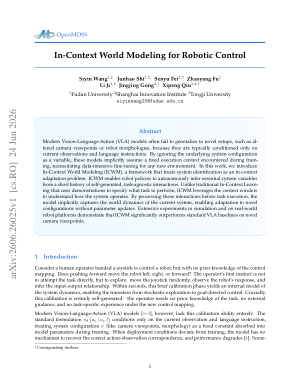
arXiv ↗Modern Vision-Language-Action (VLA) models often fail to generalize to novel setups, such as altered camera viewpoints or robot morphologies, because they are typicall
💛 51
25,823 papers across 0 tags, ranked by community signal and explained.
Modern Vision-Language-Action (VLA) models often fail to generalize to novel setups, such as altered camera viewpoints or robot morphologies, because they are typicall
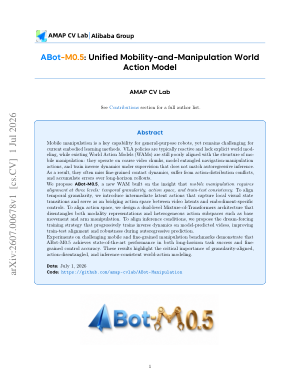
Mobile manipulation is a key capability for general-purpose robots, yet remains challenging for current embodied learning methods. VLA policies are typically reactive and
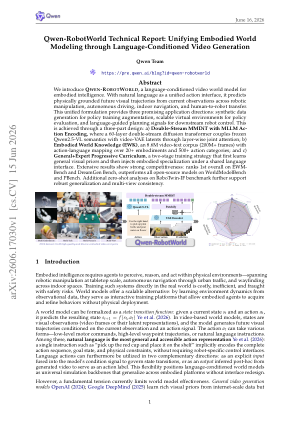
We introduce Qwen-RobotWorld, a language-conditioned video world model for embodied intelligence. With natural language as a unified action interface, it predicts phys
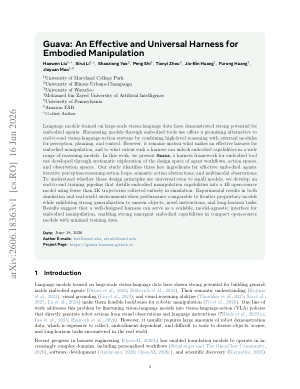
Language models trained on large-scale vision-language data have demonstrated strong potential for embodied agents. Harnessing models through embodied tools use offers a p
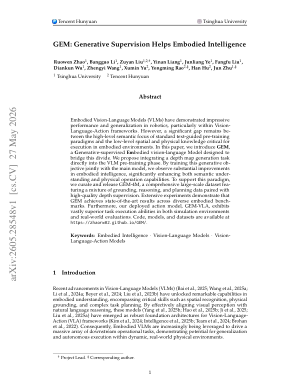
Embodied Vision-Language Models (VLMs) have demonstrated impressive performance and generalization in robotics, particularly within Vision-Language-Action frameworks. However, a si…
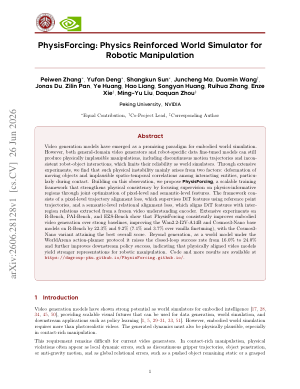
Video generation models have emerged as a promising paradigm for embodied world simulation. However, both general-domain video generators and robot-specific data fine-tu
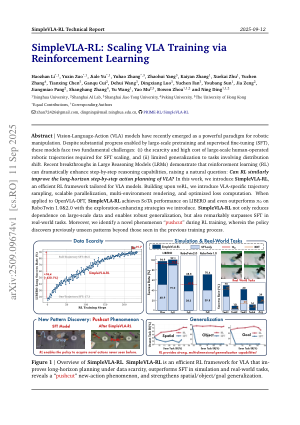
Vision-Language-Action (VLA) models have recently emerged as a powerful paradigm for robotic manipulation. Despite substantial progress enabled by large-scale pretraining and super…
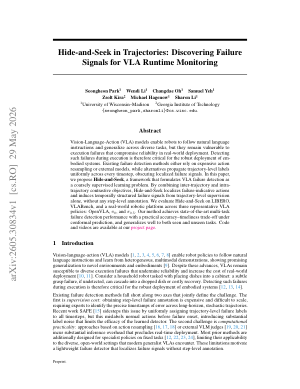
Vision-Language-Action (VLA) models enable robots to follow natural language instructions and generalize across diverse tasks, but they remain vulnerable to execution failures that…
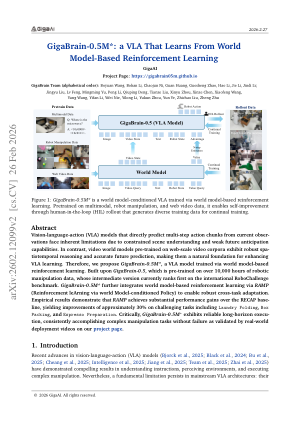
Vision-language-action (VLA) models that directly predict multi-step action chunks from current observations face inherent limitations due to constrained scene understanding and we…
Vision-Language-Action (VLA) models widely adopt pretrained Vision-Language Models (VLMs) as policy backbones, yet it remains unclear what kind of pretrained VLM representation is …
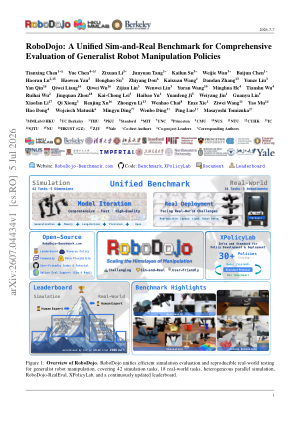
Generalist robot manipulation policies have advanced rapidly, yet existing benchmarks remain limited in systematically evaluating their capabilities. Many rely on simp
We present DeWorldSG, a novel framework that generates spatio-temporally robust 3D Semantic Scene Graphs from RGB-D sequences. Existing methods often struggle to construct
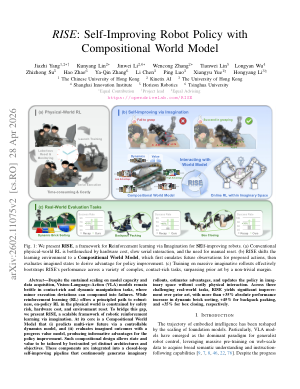
Despite the sustained scaling on model capacity and data acquisition, Vision-Language-Action (VLA) models remain brittle in contact-rich and dynamic manipulation tasks, where minor…
Vision-Language-Action (VLA) models are commonly pretrained on robot demonstrations by jointly mapping visual observations and language instructions to actions. Howeve
In this report, we present Hy-Embodied-0.5-VLA, abbreviated as HyVLA-0.5, an end-to-end system that spans the full robot learning stack: data collection, model design, continued pr…
Vision-Language Models (VLMs) enable robots to follow open-language instructions. However, dense VLM embeddings have shown to be noisy and lack spatial consistency. This i
Video predictive models are emerging as a powerful paradigm in robotics, offering a promising path toward task generalization, long-horizon planning, and flexible decisi
Manipulating fast and dynamically moving targets in unstructured 3D environments remains challenging for embodied AI. Existing visual-language-action models and world mode
General-purpose vision-language-action models benefit from large vision-language priors, but effective manipulation also requires anticipating action-relevant scene change
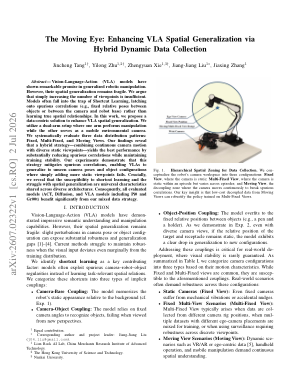
Vision-Language-Action (VLA) models have shown remarkable promise in generalized robotic manipulation. However, their spatial generalization remains fragile. We argue that
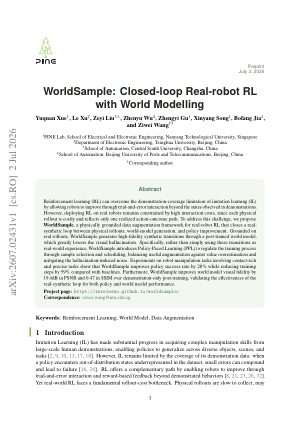
Reinforcement learning (RL) can overcome the demonstration-coverage limitation of imitation learning (IL) by allowing robots to improve through trial-and-error interaction
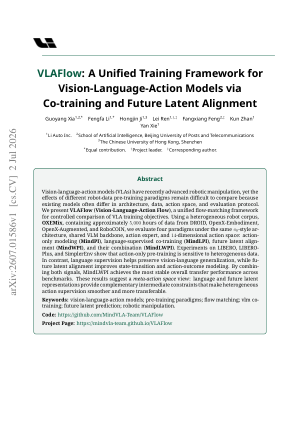
Vision-language-action models (VLAs) have recently advanced robotic manipulation, yet the effects of different robot-data pre-training paradigms remain difficult to comp
Achieving humanlike dexterity with anthropomorphic multifingered robotic hands requires precise finger coordination. However, dexterous manipulation remains highly challenging beca…
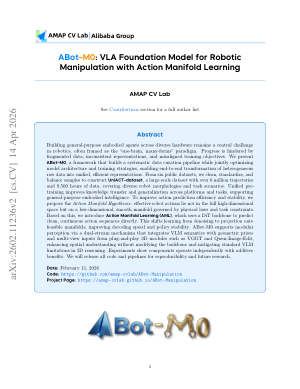
Building general-purpose embodied agents across diverse hardware remains a central challenge in robotics, often framed as the ''one-brain, many-forms'' paradigm. Progress is hinder…