May 2026
StepAudio 2.5 Technical Report
arXiv ↗Unified audio-language modeling has emerged as a prominent trend in modern speech systems, promising to bring the reasoning capabilities of large language models to auditory tasks.…
💛 42
12,389 papers across 0 tags, ranked by community signal and explained.
Unified audio-language modeling has emerged as a prominent trend in modern speech systems, promising to bring the reasoning capabilities of large language models to auditory tasks.…
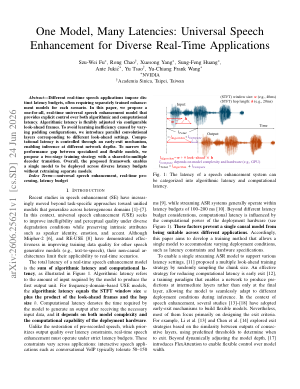
Different real-time speech applications impose distinct latency budgets, often requiring separately trained enhancement models for each scenario. In this paper, we pro
Zero-shot text-to-speech (TTS) has improved substantially for single-speaker synthesis, yet expressive long-form multi-speaker dialogue remains difficult. A common workaround is to…
We introduce Voxtral TTS, an expressive multilingual text-to-speech model that generates natural speech from as little as 3 seconds of reference audio. Voxtral TTS adopts a hybrid …
We present ChildVox, a novel benchmark for characterizing the diverse acoustic signals through which children communicate. Specifically, ChildVox follows the full developmental tra…
As the paradigm of AI shifts from text-based LLMs to Speech Language Models (SLMs), there is a growing demand for full-duplex systems capable of real-time, natural human-computer i…
Discrete audio tokenizers are fundamental to empowering large language models with native audio processing and generation capabilities. Despite recent progress, existing approaches…
Code-switching -- the natural alternation between two languages within a single utterance -- remains one of the most challenging and under-studied conditions for automatic speech r…
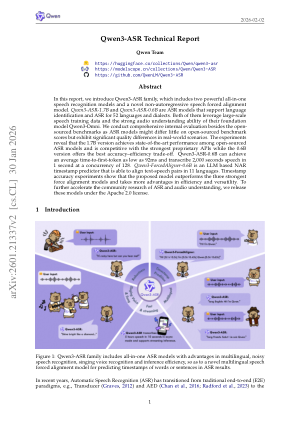
In this report, we introduce Qwen3-ASR family, which includes two powerful all-in-one speech recognition models and a novel non-autoregressive speech forced alignment model. Qwen3-…
Autoregressive neural codec language models have shown strong zero-shot voice cloning ability, but decoder-only architectures treat input text as a prefix that competes with the gr…
Simultaneous speech-to-speech translation (SimulS2S) is essential for real-time multilingual communication, with increasing integration into meeting and streaming platforms. Despit…
Recent advances in automatic speech recognition (ASR) have explored different sequence models, including Conformer-based models and newer state space models such as Mamba.
Speech-LLM integration has shown promising results by leveraging extensive textual pretraining, yet its specific benefits for automatic speech recognition (ASR) remain u
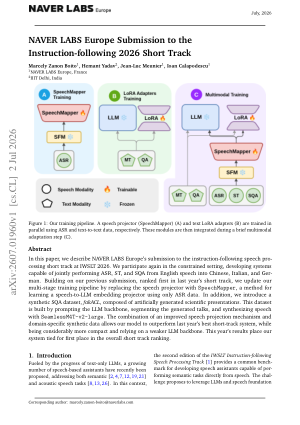
In this paper, we describe NAVER LABS Europe's submission to the instruction-following speech processing short track at IWSLT 2026. We participate again in the constrained
Instruction tuning for speech language models (SLMs) is substantially more challenging than for text-based large language models (LLMs), as it requires learning a new mo
Recent advances in duplex speech models have enabled natural, low-latency speech-to-speech interactions. However, existing models are restricted to a fixed role and voice, limiting…
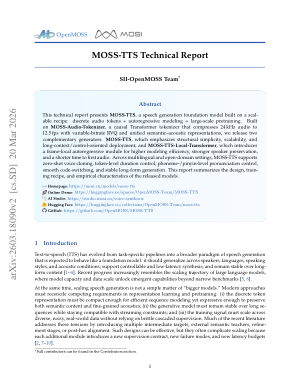
This technical report presents MOSS-TTS, a speech generation foundation model built on a scalable recipe: discrete audio tokens, autoregressive modeling, and large-scale pretrainin…
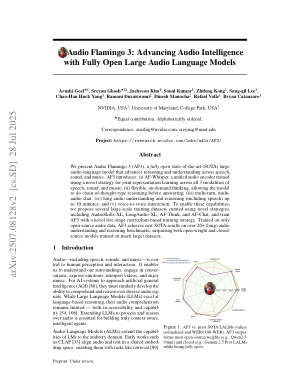
We present Audio Flamingo 3 (AF3), a fully open state-of-the-art (SOTA) large audio-language model that advances reasoning and understanding across speech, sound, and music. AF3 in…
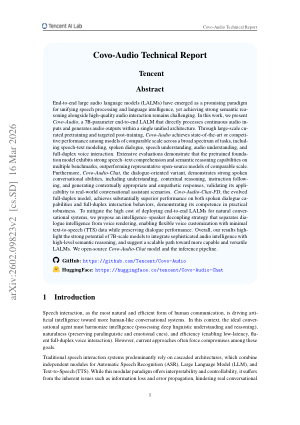
In this work, we present Covo-Audio, a 7B-parameter end-to-end LALM that directly processes continuous audio inputs and generates audio outputs within a single unified architecture…
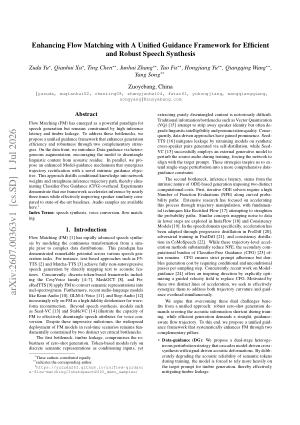
Flow Matching (FM) has emerged as a powerful paradigm for speech generation but remains constrained by high inference latency and timbre leakage. To address these bottlene
While prior work has explored emotion control in hybrid text-to-speech systems, the geometric properties of these modules, and their implications for steerability, remain
Room embeddings derived from reverberant speech are often unreliable: speech content and recording degradation can alter the representation even when speaker, room, and so
Modern automatic speech recognition (ASR) systems excel at transcribing lexical content but often omit nonverbal vocalizations (NVs), such as laughter, breaths, coughs, an
Multi-talker Automatic Speech Recognition (MTASR) faces significant challenges in accurately transcribing overlapping speech, particularly under complex high-overlap condi