Jun 2026
Orca: The World is in Your Mind
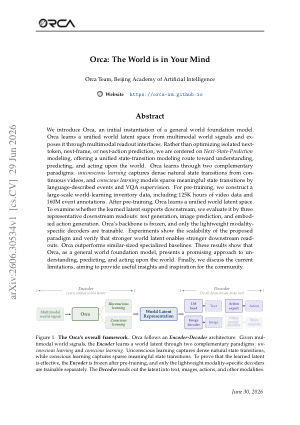
arXiv ↗We introduce Orca, an initial instantiation of a general world foundation model. Orca learns a unified world latent space from multimodal world signals and exposes it
💛 185
10,492 papers across 0 tags, ranked by community signal and explained.
We introduce Orca, an initial instantiation of a general world foundation model. Orca learns a unified world latent space from multimodal world signals and exposes it
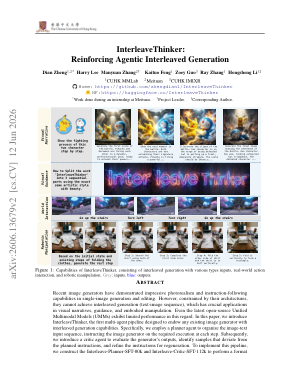
Recent image generators have demonstrated impressive photorealism and instruction-following capabilities in single-image generation and editing. However, constrained b
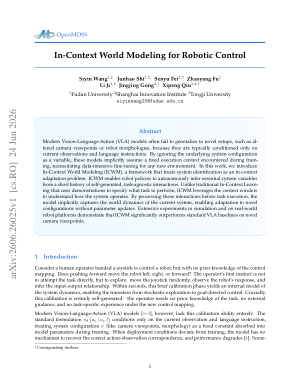
Modern Vision-Language-Action (VLA) models often fail to generalize to novel setups, such as altered camera viewpoints or robot morphologies, because they are ty
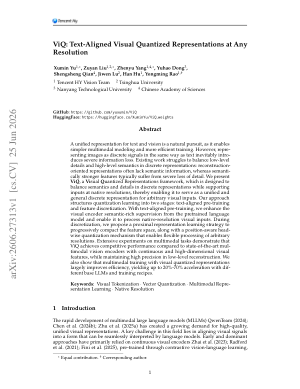
A unified representation for text and vision is a natural pursuit, as it enables simpler multimodal modeling and more efficient training. However, representing images
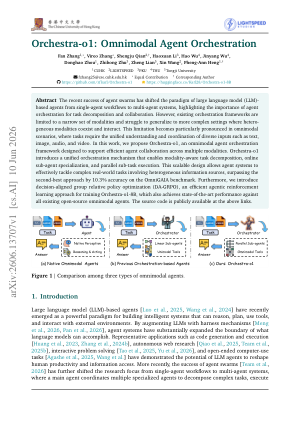
The recent success of agent swarms has shifted the paradigm of large language model (LLM)-based agents from single-agent workflows to multi-agent systems, highlighting t
Multimodal large language models (MLLMs) have achieved remarkable progress in visual understanding tasks. However, most existing MLLMs rely on autoregressive generation, w
As multi-modal models advance towards long-form video understanding, memory emerges as a critical capability. Despite substantial efforts in developing video datasets and
Fine-grained visual reasoning requires multimodal large language models (MLLMs) to identify task-relevant visual evidence and ground their reasoning in local image regions
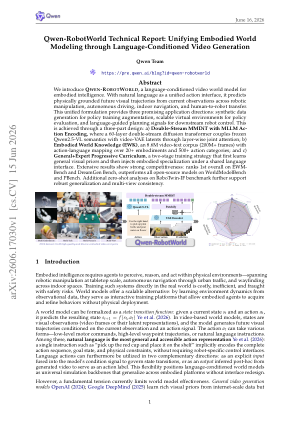
We introduce Qwen-RobotWorld, a language-conditioned video world model for embodied intelligence. With natural language as a unified action interface, it predicts phys
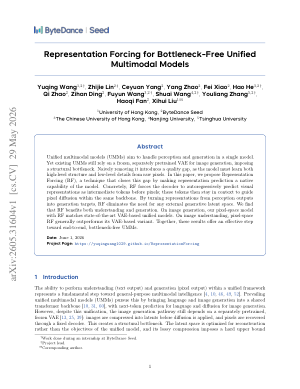
Unified multimodal models (UMMs) aim to handle perception and generation in a single model. Yet existing UMMs still rely on a frozen, separately pretrained VAE for ima
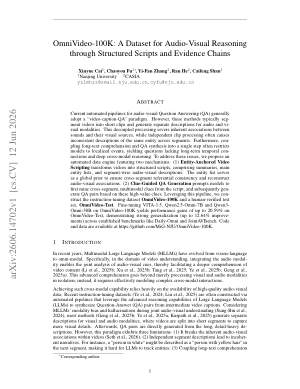
Current automated pipelines for audio-visual Question Answering (QA) generally adopt a ``video-caption-QA'' paradigm. However, these methods typically segment videos into
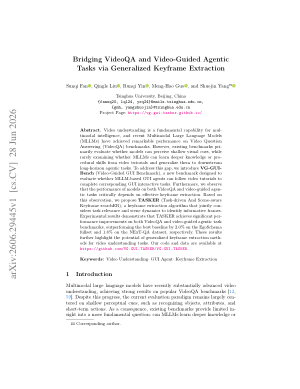
Video understanding is a fundamental capability for multimodal intelligence, and recent Multimodal Large Language Models (MLLMs) have achieved remarkable performance on Vi
Long-term memory is essential for multimodal agents to build coherent experience, accumulate world knowledge, and achieve continual learning. However, constructing effecti
Recent multimodal large language models have shown great promise in clinical image reasoning, but existing post-training pipelines remain predominantly outcome-centric, re
Existing image editing methods can be generally categorized into textual instruction-based and visual prompt-based ones. Textual instructions are semantically expressive,
Passive models for long video understanding typically rely on a "watch-it-all" paradigm, processing frames uniformly regardless of query difficulty, causing computationa
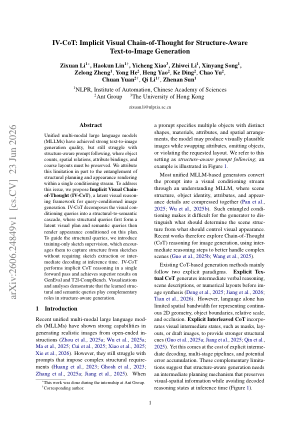
Unified multi-modal large language models (MLLMs) have achieved strong text-to-image generation quality, but still struggle with structure-aware prompt following, where ob
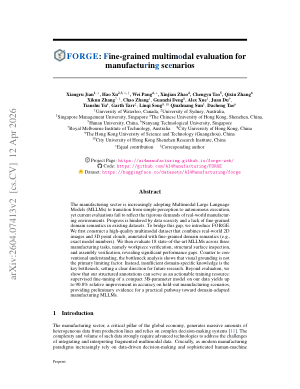
The manufacturing sector is increasingly adopting Multimodal Large Language Models (MLLMs) to transition from simple perception to autonomous execution, yet current evaluations fai…
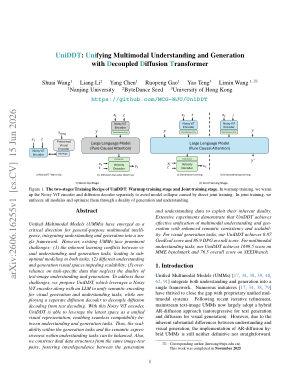
Unified Multimodal Models (UMMs) have emerged as a critical direction for general-purpose multimodal intelligence, integrating understanding and generation into a single f
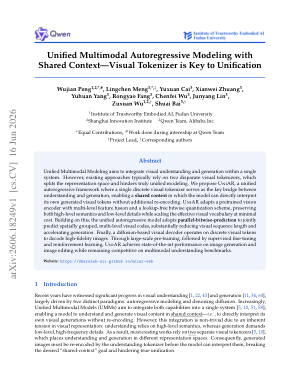
Unified Multimodal Modeling aims to integrate visual understanding and generation within a single system. However, existing approaches typically rely on two disparate
Video-language models can process only a limited number of frames, making frame selection a key bottleneck for efficient video captioning. Most captioning pipelines still
Spatial VLMs have made substantial progress in geometric perception, yet complex spatial reasoning requiring multi-step inference over depth, distance, and scene relations
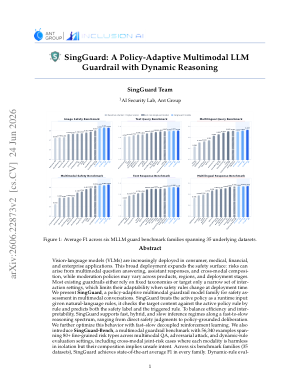
Vision-language models (VLMs) are increasingly deployed in consumer, medical, financial, and enterprise applications. This broad deployment expands the safety surface:
Humans paint images incrementally: they plan a global layout, sketch a coarse draft, inspect, and refine details, and most importantly, each step is grounded in the evolving visual…