Program-as-Weights: A Programming Paradigm for Fuzzy Functions
arXiv βMany everyday programming tasks resist clean rule-based implementation, such as alerting on important log lines, repairing malformed JSON, or ranking search results by i
7,708 papers across 0 tags, ranked by community signal and explained.

Many everyday programming tasks resist clean rule-based implementation, such as alerting on important log lines, repairing malformed JSON, or ranking search results by i

Code language models need repository-level context to resolve imports, APIs, and project conventions. Existing methods inject this knowledge as long inputs (retrieved through RAG oβ¦

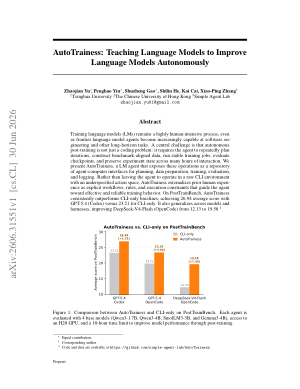
Training language models (LMs) remains a highly human-intensive process, even as frontier language model agents become increasingly capable at software engineering and oth

One-shot Program-of-Thought (PoT) emits a Python program that prints a primitive-action plan; a single invalid action silently invalidates the trajectory. We introduce RePoT (Recovβ¦

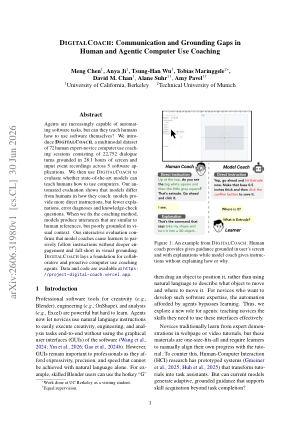
Agents are increasingly capable of automating software tasks, but can they teach humans how to use software themselves? We introduce DigitalCoach, a multimodal dataset of

Consensus protocols form the backbone of distributed systems and blockchains, where implementation bugs can cause data corruption and financial losses. While LLM-based app

GPU kernel optimization is fundamental to modern deep learning but remains a highly specialized task requiring deep hardware expertise. Despite strong performance in general prograβ¦

AI coding agents are increasingly used to write real-world software, but ensuring that their outputs are correct remains a fundamental challenge. Formal verification offers a promiβ¦

Large language models (LLMs) are typically evaluated on code generation and program repair using binary functional correctness: a generated program or patch either passes

Vulnerability exploits play a crucial role in assessing the downstream impact of Java library vulnerabilities. While some vulnerabilities are accompanied by disclosed expl

In LLM-assisted software development, coding is often iterative. We study regression accumulation in multi-turn LLM programming conversations, where later code suggestions

The use of LLMs in software development has become increasingly widespread on tasks such as code generation and summarization. Reports from large technology companies show

LLM-integrated applications blend natural language prompts with program code, and much of their runtime behavior originates in the prompt layer rather than in the code i

In recent years, it has become increasingly evident that large language models (LLMs) and autonomous agents raise the level of abstraction in software development by shift

Vibe coding democratizes software development by allowing users to generate code via natural-language (NL) interaction with large language models (LLMs). However, the code

Software tests and code evolve together: a code change should be followed by new or updated tests that record the new software behavior. Yet existing test generation and u

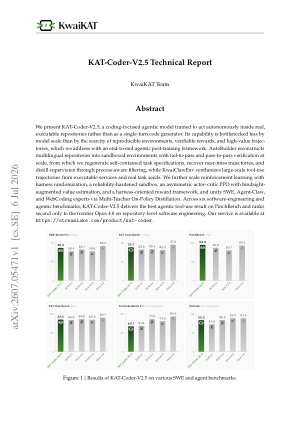
We present KAT-Coder-V2.5, a coding-focused agentic model trained to act autonomously inside real, executable repositories rather than as a single-turn code generator. Its

Detecting vulnerability-inducing commits (VICs) at submission time is critical for improving the security and reliability of software systems. However, this task is highly

Code generation with large language models (LLMs) remains unreliable because generated programs can appear correct while still violating key semantic requirements in the n

Integration of web APIs is a cornerstone of modern software systems, yet writing correct web API invocation code remains challenging due to complex and evolving API specif

Neural decompilation is increasingly studied as a code-generation problem, yet its evaluation methodology remains underdeveloped for modern languages. We present a systema

Formal verification offers the strongest guarantee of software correctness, but it does not scale: the proofs demanded by interactive theorem provers such as Coq require

Producing a labeled vulnerable code at scale is a recurring obstacle for learning-based vulnerability detection: mined corpora carry substantial label noise, and existin

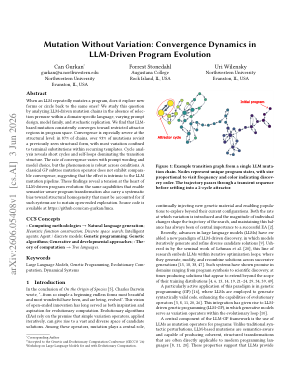
When an LLM repeatedly mutates a program, does it explore new forms or circle back to the same ones? We study this question by analyzing LLM-driven mutation chains in the