Qwen-AgentWorld: Language World Models for General Agents
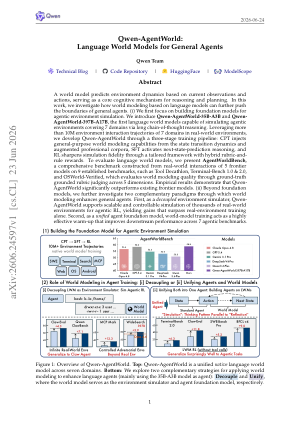
arXiv βA world model predicts environment dynamics based on current observations and actions, serving as a core cognitive mechanism for reasoning and planning. In this work, we i
9,975 papers across 0 tags, ranked by community signal and explained.

A world model predicts environment dynamics based on current observations and actions, serving as a core cognitive mechanism for reasoning and planning. In this work, we i

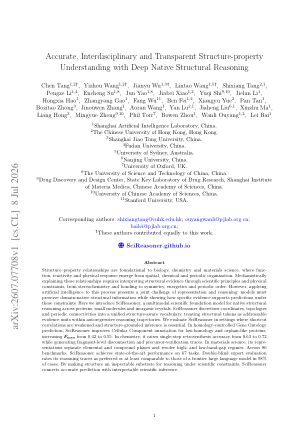
Structure-property relationships are foundational to biology, chemistry and materials science, where function, reactivity and physical response emerge from spatial, chem

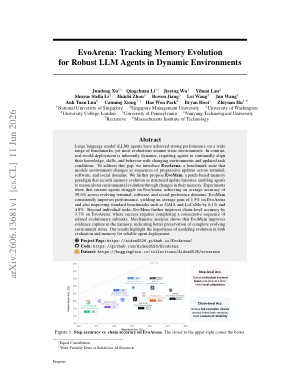
Large language model (LLM) agents have achieved strong performance on a wide range of benchmarks, yet most evaluations assume static environments. In contrast, real-wo

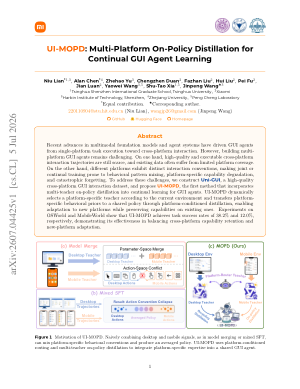
Recent advances in multimodal foundation models and agent systems have driven GUI agents from single-platform task execution toward cross-platform interaction. However,

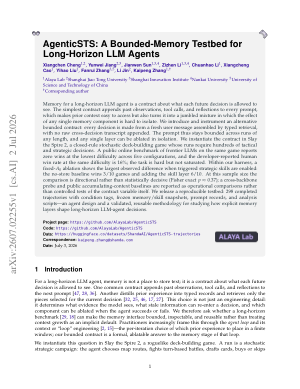
Memory for a long-horizon LLM agent is a contract about what each future decision is allowed to see. The simplest contract appends past observations, tool calls, and refle

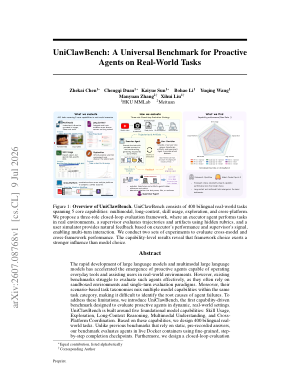
The rapid development of large language models and multimodal large language models has accelerated the emergence of proactive agents capable of operating everyday tools a

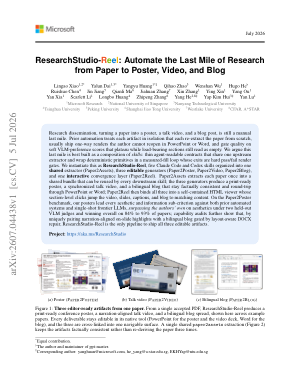
Research dissemination, turning a paper into a poster, a talk video, and a blog post, is still a manual last mile. Prior automation treats each artifact in isolation tha

Recent advances in agentic Reinforcement Learning (RL) have substantially improved the multi-turn tool-use capabilities of large language model agents. However, most exist

Autonomous agents are increasingly expected to improve executable policies through feedback, yet existing evaluations often collapse this process into a final score or con

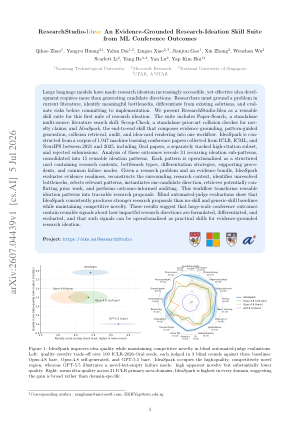
Large language models have made research ideation increasingly accessible, yet effective idea development requires more than generating candidate directions. Researchers m

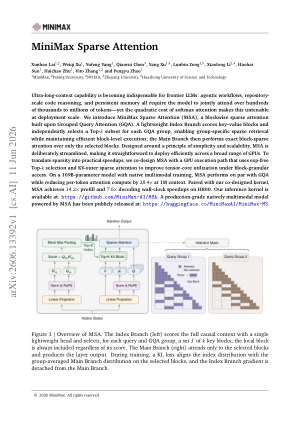
Ultra-long-context capability is becoming indispensable for frontier LLMs: agentic workflows, repository-scale code reasoning, and persistent memory all require the mo

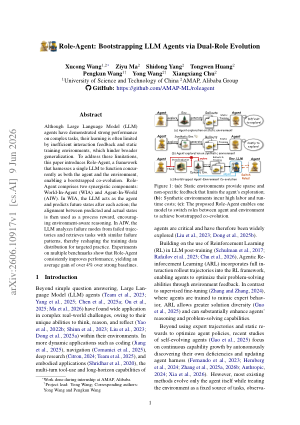
Although Large Language Model (LLM) agents have demonstrated strong performance on complex tasks, their learning is often limited by inefficient interaction feedback and static traβ¦

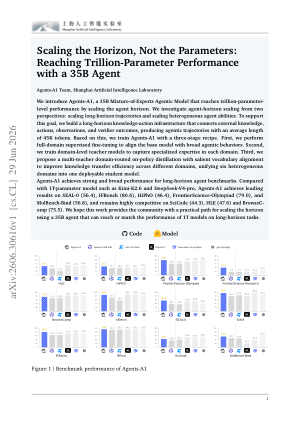
We introduce Agents-A1, a 35B Mixture-of-Experts Agentic Model that reaches trillion-parameter-level performance by scaling the agent horizon. We investigate agent-horizon

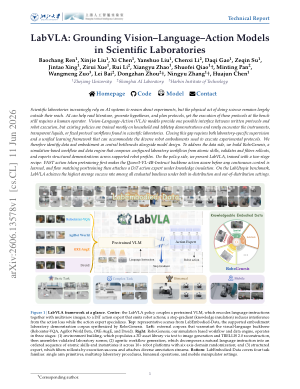
Scientific laboratories increasingly rely on AI systems to reason about experiments, but the physical act of doing science remains largely outside their reach. A

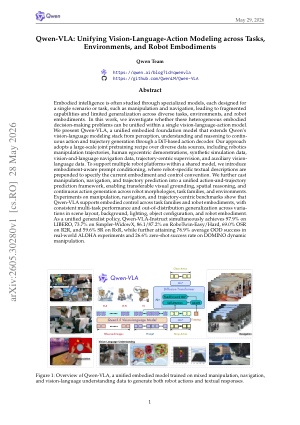
Embodied intelligence is often studied through specialized models for individual tasks such as manipulation or navigation, resulting in fragmented capabilities a

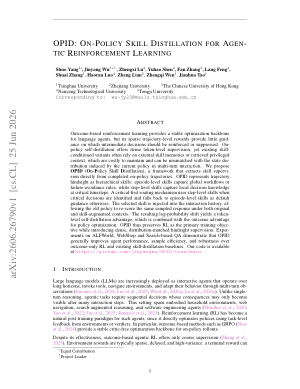
Outcome-based reinforcement learning provides a stable optimization backbone for language agents, but its sparse trajectory-level rewards provide little guidance on which

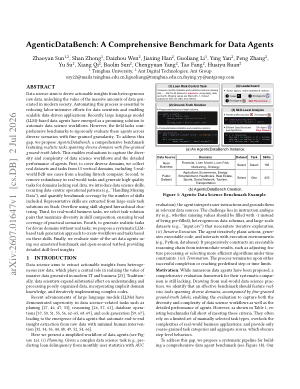
Data science aims to derive actionable insights from heterogeneous raw data, unlocking the value of the massive amounts of data generated in modern society. Automating t

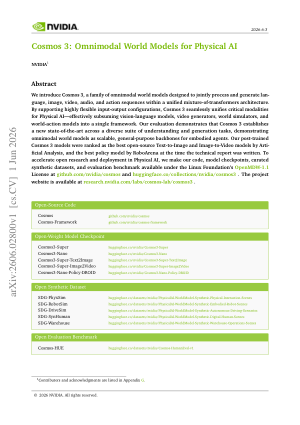
We introduce Cosmos 3, a family of omnimodal world models designed to jointly process and generate language, image, video, audio, and action sequences within a u

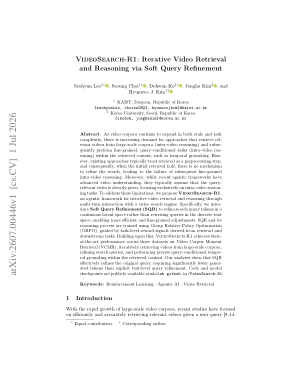
As video corpora continue to expand in both scale and task complexity, there is increasing demand for approaches that retrieve relevant videos from large-scale corpora (

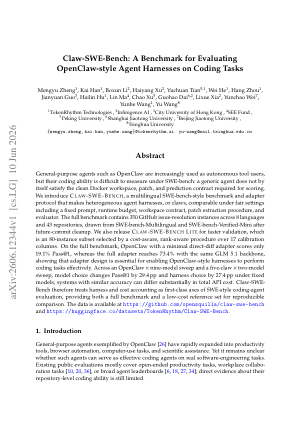
General-purpose agents such as OpenClaw are increasingly used as autonomous tool users, but their coding ability is difficult to measure under SWE-bench: a generic agent d

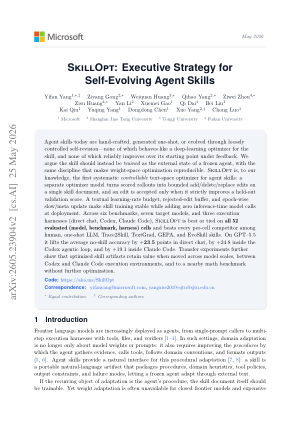
Agent skills today are hand-crafted, generated one-shot, or evolved through loosely controlled self-revision, none of which behaves like a deep-learning optimizer for

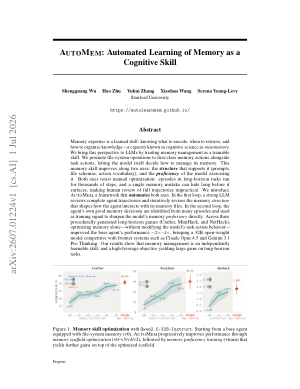
Memory expertise is a learned skill: knowing what to encode, when to retrieve, and how to organize knowledge--a capacity known in cognitive science as metamemory. We bring

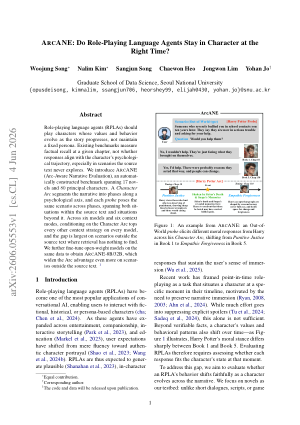
Role-playing language agents (RPLAs) should play characters whose values and behavior evolve as the story progresses, not maintain a fixed persona. Existing benchmarks m

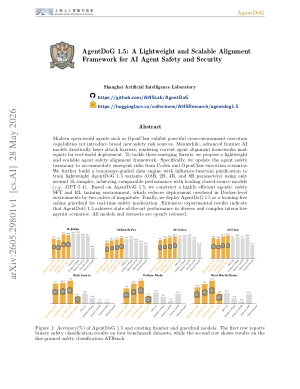
Modern open-world agents such as OpenClaw exhibit powerful cross-environment execution capabilities yet introduce broad new safety risk sources. Meanwhile, advanced fronti